

In the urban enterprise landscape of Delhi NCR—spanning DLF Cyber City, Golf Course Road, Aerocity, and Noida Expressway—corporate occupiers operate in an environment characterized by extreme outdoor air pollution (winter AQI spikes regularly exceeding 400+) and high-density, screen-intensive work routines. Sealed inside glass-enclosed, mechanically ventilated high-rises, employees spend over 90% of their working hours disconnected from nature. The result is documented across modern workplace studies: “Sick Building Syndrome,” dry eye syndrome, mental fatigue, elevated cortisol levels, and afternoon cognitive exhaustion.
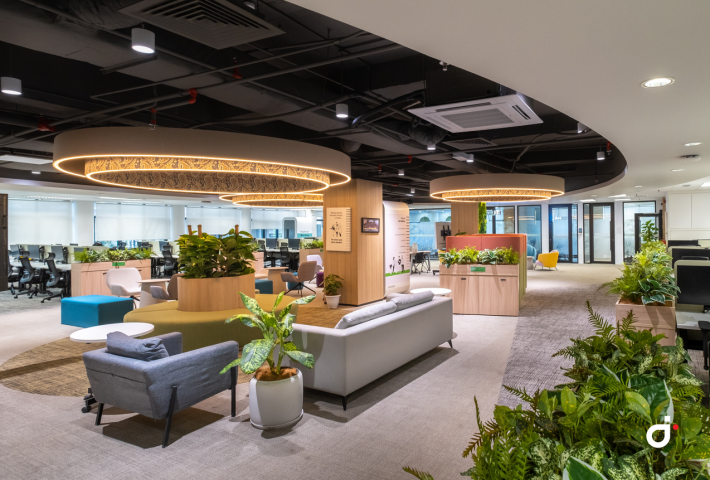
To combat indoor environmental degradation and enhance talent retention, forward-thinking enterprises are transitioning from sterile, synthetic offices to Biophilic Interior Architecture. Grounded in the WELL Building Standard v2 and LEED Platinum frameworks, biophilic office design goes far beyond placing occasional potted ficus plants in corridors. It represents a calculated, engineered integration of living hydroponic plant walls, dynamic circadian grow lighting, nontoxic organic materials, natural fractals, and micro-climate humidity balancing.
As premier commercial interior design and turnkey fit-out contractors in Delhi NCR, BR Creative designs, manufactures, and integrates automated living green walls and biophilic spatial concepts that actively filter indoor air, dampen acoustic reverberation, and revitalize corporate productivity.
1. The Science of Biophilia: Cognitive, Acoustic & IAQ Benefits
Scientific and ergonomic data demonstrates how nature-connected architecture delivers tangible business returns:
| Performance Dimension | Observed Workplace Challenge | Biophilic Architectural Solution & Impact |
| Indoor Air Quality (IAQ) & VOCs | Off-gassing from synthetic carpets, adhesives, and laminates elevates formaldehyde, benzene, and CO2 (>1,000 ppm). | Active phytoremediation through dense living walls absorbs VOCs, reduces CO2, and releases fresh oxygen directly into occupant zones. |
| Acoustic Attenuation (Reverberation) | Polished concrete, glass cabins, and drywall surfaces create severe echo corridors (RT60 > 0.8s). | Living foliage and moss walls act as natural acoustic diffusers, absorbing mid-to-high frequency speech noise (NRC 0.65–0.80). |
| Micro-Climate & Static Electricity | Continuous air conditioning drops relative humidity below 30%, drying vocal cords and generating static electrical discharge risks. | Plant transpiration naturally restores indoor relative humidity to the ideal 40%–55% zone, soothing respiratory tracts and skin. |
| Cognitive Focus & Stress Recovery | Constant digital screen exposure induces directed-attention fatigue, elevating stress hormones and reducing focus. | Visual connection with natural greenery and organic wood fractals triggers involuntary attention, reducing cortisol by up to 15%. |
2. Engineered Living Green Wall Systems: Soil-Based vs. Hydroponic
Understanding vertical garden engineering systems ensures long-term facility health and zero water leakage:
| System Parameter | Automated Hydroponic Felt / Modular Tray System | Traditional Soil-Based Pot Grid System |
| Substrate & Soil Medium | 100% Soil-Less: Plants root in inorganic rockwool, geotextile synthetic felt, or LECA expanded clay balls. | Uses organic topsoil or potting mix compost inside individual modular plastic pots. |
| Pest & Indoor Hygiene Risk | Zero Pest Breeding: Eliminates fungus gnats, soil-borne bacteria, mold spores, and earthy odors inside commercial zones. | High risk of insect infestation, fungus gnats, and mold spore dispersion through the HVAC system. |
| Structural Weight on Walls | Lightweight (25–35 kg/m² fully saturated): Can be mounted safely on reinforced drywall partitions or elevator shafts. | Heavy (60–90 kg/m² saturated): Requires heavy-duty structural masonry or supplementary steel sub-framing. |
| Irrigation & Nutrient Delivery | Closed-Loop Automated Drip: Micro-drip lines deliver water with dissolved liquid nutrients on automated digital timers. | Manual or semi-automated watering prone to pot overflow, dry patches, and water dripping onto carpets. |
| Leak Prevention & Drainage | Fabricated with welded marine-grade aluminum or continuous EPDM-lined catchment trays with direct drain plumbing. | Individual pot drip trays prone to clogging, overflowing, and staining expensive office flooring. |
3. The Essential Elements of Biophilic Workplace Architecture
A comprehensive biophilic corporate fit-out integrates four core architectural disciplines:
- Hydroponic Living Feature Walls: Positioned in high-visibility corporate zones—such as reception lobbies, main atrium corridors, and cafeteria town halls. We integrate air-purifying, low-light indoor species certified by NASA clean air studies: Philodendron, Epipremnum aureum (Money Plant), Aglaonema, Sansevieria, and Chlorophytum comosum.
- Preserved Reindeer Moss & Acoustic Art: For windowless boardrooms, executive cabins, and video-conference suites where live irrigation is unfeasible, we install preserved Scandinavian reindeer moss walls. Requiring zero water, soil, or sunlight, preserved moss absorbs sound (NRC 0.70+) while providing tactile greenery.
- Full-Spectrum Horticultural Grow Lighting: Plants inside commercial towers cannot thrive on standard 4000K office LED troffers. We install specialized high-CRI (>90), 450nm blue and 660nm red spectrum LED grow lights hidden in ceiling recessed troughs, providing 1,500 to 2,500 LUX for photosynthesis without harsh glare.
- Natural Wood Joinery & Biomorphic Fractals: Replacing sterile cold laminates with FSC-certified natural teak, ash, or oak veneers, fluted acoustic timber paneling, and organically curved partition walls that mimic natural patterns.
4. 2026 Cost Benchmarking: Living Walls & Biophilic Fit-Outs in Delhi NCR
Supply, engineering, and installation cost benchmarks across Gurgaon, Delhi, and Noida commercial projects:
| Biophilic System Deliverable | Estimated Cost Range (INR) | Engineering & Hardware Specifications Included |
| Hydroponic Living Wall (Modular Tray / Felt) | ₹1,400 – ₹2,200 / sq. ft. | Marine-grade catchment tray, automated multi-zone drip lines, soil-less media, air-purifying foliage, digital timer. |
| Preserved Scandinavian Moss Wall (Zero Maintenance) | ₹1,800 – ₹2,800 / sq. ft. | 100% naturally preserved reindeer moss, acoustic backing board, custom colors (Spring Green, Moss Green), NRC 0.70+. |
| Horticultural LED Grow Light Array | ₹6,500 – ₹12,000 / linear meter | High-CRI (>90) photosynthetically active radiation (PAR) spectrum ceiling linear trough fixtures with digital timer controls. |
| Integrated Planter Boxes in Linear Benching | ₹850 – ₹1,400 / running foot | Powder-coated aluminum or FRP leakproof planter troughs integrated into desk center spines with sub-irrigation wicks. |
Why Enterprises Choose BR Creative for Biophilic Fit-Outs
- Turnkey Architectural & MEP Integration: We eliminate finger-pointing between decorators and MEP contractors. Our in-house plumbing and electrical engineers integrate living wall drainage and grow-lighting circuits directly into the 3D Combined Services Drawings (CSD).
- Double-Layer Waterproofing Guarantees: Vertical green wall installations feature two coats of elastomeric polyurethane waterproofing behind the framework and welded stainless-steel catch basins to prevent any moisture contact with base-building drywall.
- Fixed-Rate BOQ Cost Certainty: Comprehensive line-item BOQs with locked hardware makes, botanical species specifications, and automated irrigation pumps ensure complete budget predictability.
- Post-Handover Horticultural Maintenance Programs: We provide turnkey quarterly maintenance contracts covering plant nutrient replenishment, horticultural pruning, irrigation line flushing, and pest inspections.
5-Phase Biophilic Engineering & Installation Roadmap
- Light & Moisture Due Diligence (Days 1–8): Conducting lux level mapping, evaluating wall structural load capacity, and planning plumbing water-inlet and drain line hookups.
- Sub-Frame & Waterproofing Membrane (Days 10–22): Installing galvanized anti-corrosion unistrut framing, applying dual polyurethane waterproofing coats, and plumbing the drain trough.
- Automated Irrigation & Grow Light Hookup (Days 20–35): Routing micro-drip emitters, connecting digital solenoid valves, and mounting recessed horticultural LED grow lights in the ceiling.
- Botanical Planting & Acclimatization (Days 35–48): Securing soil-less root modules, planting NASA-approved indoor species in artistic flowing patterns, and testing automated irrigation cycles.
- Hydraulic Testing, Air Balancing & Handover (Final 5–7 Days): Performing 48-hour continuous drip cycle leak tests, verifying nutrient dosing, and handing over the maintenance manual.
Frequently Asked Questions (FAQs)
Q1. How do you prevent living walls from leaking water onto corporate carpets and flooring?
BR Creative implements a fail-safe dual-containment engineering protocol: the entire vertical wall area is lined with an impervious marine-grade backing board coated with elastomeric polyurethane waterproofing. Beneath the plant modules, a continuous welded heavy-gauge aluminum or stainless steel catchment trough collects drainage runoff and directs it into the building’s plumbing stack via a hard-plumbed drain pipe. In addition, moisture sensors trigger an emergency water shutoff valve if drainage water levels rise abnormally.
Q2. Can live plants survive inside windowless boardrooms and deep interior office floor plates?
Yes, through the installation of dedicated horticultural LED grow lights. Standard office fluorescent or 4000K LED lights do not produce the photosynthetic wavelengths plants require. We install specialized high-CRI fixtures that emit concentrated blue (450nm) and red (660nm) light spectra, providing the necessary 1,500 to 2,500 LUX to keep plants flourishing indoors. For spaces where grow lights cannot be fitted, we install 100% naturally preserved Scandinavian reindeer moss walls, which require no light or water.
Q3. Do indoor living walls attract insects, pests, or create unpleasant damp smells?
No. Unlike outdoor gardens, our commercial indoor green walls are 100% soil-less (hydroponic). Plants grow in sterile inorganic substrates such as rockwool, LECA expanded clay, or synthetic felt. Because there is no organic topsoil, gnats, soil bugs, and mold cannot reproduce. Automated liquid nutrient dosing ensures fresh, clean water circulation without standing stagnant water or earthy smells.
Q4. How much ongoing maintenance does an indoor living green wall require?
Because irrigation, lighting, and fertilization are automated via digital timers, on-site facility teams have zero day-to-day watering duties. A professional horticultural technician visits once or twice a month to inspect plant health, prune overgrown foliage, refill the liquid nutrient reservoir, and clean the drip emitters. BR Creative provides comprehensive Annual Maintenance Contracts (AMC) to handle this end-to-end.
Q5. How does biophilic design contribute to WELL Building Standard v2 and LEED certification?
Biophilic elements contribute directly to the WELL v2 “Mind” and “Air” concepts by providing natural views, reducing mental fatigue, and improving indoor air quality. Under LEED v4/v4.1, biophilic design supports credits in Indoor Environmental Quality (EQ) for enhanced indoor air quality, low-emitting materials, and thermal/acoustic comfort.
Q6. How can corporate occupiers schedule a biophilic site feasibility audit with BR Creative?
Corporate founders, CFOs, and facility directors can connect directly with BR Creative through their official website or corporate helpline to schedule an on-site lighting assessment, plumbing tap-off audit, and receive an itemized turnkey living wall BOQ proposal.
Conclusion
In a competitive business landscape and harsh urban climate, biophilic architecture is an investment in human capital, employee well-being, and brand prestige. Partnering with seasoned commercial interior design and turnkey fit-out contractors in Delhi NCR like BR Creative guarantees that your living walls and biophilic workspaces are engineered for zero leakage, long-term botanical health, and rapid turnkey delivery strictly on time and within budget.